
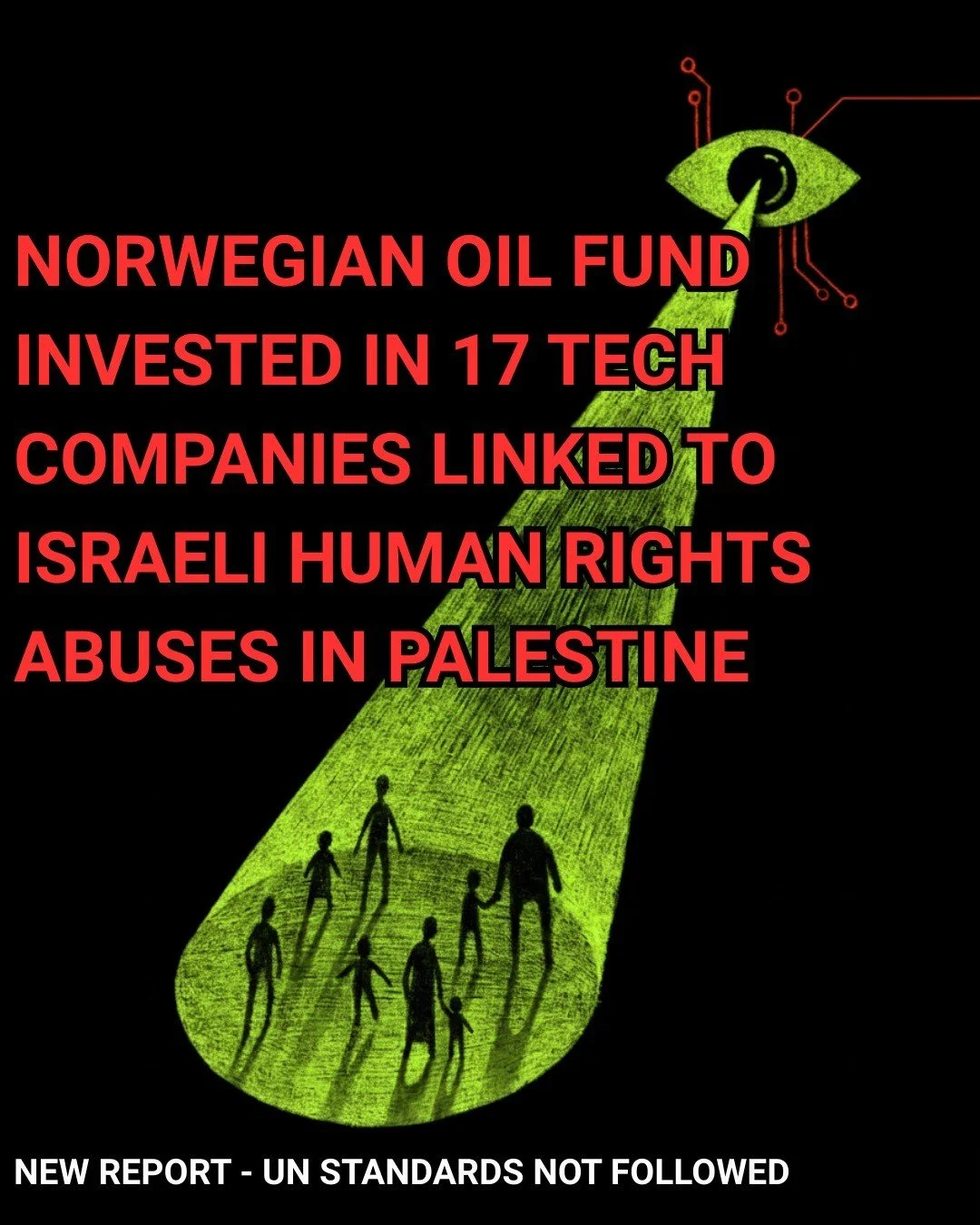
ATROCITY STOCKS
NORWAY’S OIL FUND INVESTED IN 17 TECHNOLOGY COMPANIES WITH CONNECTIONS TO ISRAELI HUMAN RIGHTS ABUSES IN PALESTINE
UN AND OECD GUIDELINES HAVE NOT BEEN IMPLEMENTED
Oslo, Norway (February 24, 2026) – A new study finds that the Norwegian Government Pension Fund Global (the Fund) has investments in 17 technology companies with business ties to the Israeli military or other actors in the Israeli security and defence sector. Several of these companies have contributed products and services for surveillance systems and AI-based tools to the Israeli military. The UN and international courts link the Israeli military and Israeli security forces to war crimes, illegal occupation, apartheid and genocide against Palestinians.
Investments in these companies expose the Fund to legal and reputational risks and link Norway to possible international crimes committed by Israel. The new study shows that the Fund could have managed these risks by adopting the UN Guiding Principles and the OECD Guidelines for Responsible Business. However, Norges Bank Investment Management (NBIM) and the Ethical Council that used to conduct screening have failed to implement these international standards. The result is that the Fund is ill-equipped to address its exposure to the risk its investee companies are linked to human rights abuses.
The investigation, conducted by a small group of experts over just a few weeks, identified Israeli and foreign companies – including Microsoft, Google, Amazon and Palantir – that have supplied, among other things, cameras, biometrics, facial recognition, cloud services or AI systems to the Israeli Defence Forces (IDF) and other Israeli authorities and businesses. These products and services are linked to targeted attacks against Palestinians through systems such as Lavender, which allegedly generates lists of people to be killed by the Israeli military, and Where’s Daddy, which allegedly tracks targets to their homes.
“It took our volunteer team a short time to apply these standards and identify 17 high-risk companies in the oil fund’s portfolio,” says Maja van der Velden, professor of computer science at the University of Oslo. “We call on the Fund to do its job and ensure that our pensions do not support Israel’s genocide of the Palestinians. A risk-based approach would make this possible.”
In contrast to the Ethical Council’s “high threshold” for engagement, the UN Guiding Principles and the OECD Guidelines require companies to be aware of the risks of adverse human rights impacts associated with their operations, products, and services, and to demonstrate how they address these. This risk-based approach shifts responsibility from the oil fund to portfolio companies and facilitates rapid divestment of companies that do not comply with the regulations. These are the same standards enshrined in Norway’s Transparency Act (2022) and EU directives (2025).
By suspending the ethical guidelines in November 2025, the government explicitly gave NBIM the authority to divest from irresponsible companies, while also giving NBIM the mandate to reinvest in companies that were previously excluded. The government nevertheless maintained the legal limitations on the overall scope of permitted divestments. NBIM has, not unexpectedly, chosen to interpret its new mandate in a way that prevents divestments.
The committee appointed by the government to review the ethics framework of the Fund will not report until October 2026, and changes to the framework will then have to be approved by the government, which will do so at the earliest when it considers the committee’s report in spring 2027. This is far too late. Although violence against Palestinians has decreased in intensity, killings and ethnic cleansing continue in Gaza and the West Bank.
Recommendations
NBIM should immediately withdraw the Fund from companies that do not exercise due diligence to respect human rights in Palestine. Priority should be given to companies that clearly do not avoid, prevent, limit or remedy the ongoing risk of their link to illegal occupation, war crimes, crimes against humanity (including apartheid) or genocide.
The Minister of Finance should immediately instruct NBIM to use its mandate for divestment in line with the risk-based standard for due diligence, as set out in the UNGP and OECD guidance for investors. The government should lift restrictions on NBIM's divestment mandate. As a minimum requirement, the Ministry of Finance should expand the overall scope for sell-offs relative to the benchmark index.
•
•
Brought to you buy the folks behind the *Atrocity-Free Tech* list (click here!)
• • Brought to you buy the folks behind the *Atrocity-Free Tech* list (click here!)